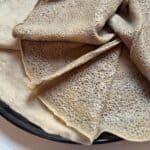
How to Make Injera
Injera is the traditional accompaniment to zigni. It is a large, soft, sour flatbread made from teff flour and fermented over several days, giving it its distinctive tang and spongy, hole-pocked surface. It takes time rather than skill: the fermentation does the work.
Servings 8 flatbreads
Calories 114kcal
Ingredients
- 250 g teff flour (2 cups)
- 710 mls filtered or spring water or spring water (3 cups)
- ¼ teaspoon salt
Instructions
- Make the batter. Whisk 250 g teff flour with 710 mls filtered or spring water until smooth, roughly the consistency of thin pancake batter. Transfer to a large glass or ceramic bowl leaving plenty of room, as it will rise.
- Ferment. Cover loosely with a cloth and leave at room temperature (21–24°C / 70–75°F) for 3–4 days. Don't stir it. Bubbles will appear on the surface and it will develop a distinctly sour smell, these are good signs that fermentation is taking place. A little clear liquid on top is normal and a small amount of surface mould can be scooped off and discarded.
- Pour off the liquid. On the final day, pour away the water that has collected on top and discard anything floating on it.
- Cook the absit (thickener). Take about 120 g or half a cup of batter, mix it with 240 ml or a cup of water in a small pan and heat gently, stirring, until it thickens to a loose paste. Stir this back into the main batter along with ¼ tsp salt. This step gives injera its characteristic softness. Loosen with a little water if needed, the batter should pour easily.
- Cook. Heat a large non-stick pan over medium heat with no oil. Pour the batter in a spiral from the outside inwards, covering the base in a thin layer. Cover with a lid and cook, do not flip. The top will set and fill with tiny holes and the edges will lift after 2-3 minutes. Remove and cool on a cloth.
- Repeat with the remaining batter, stacking the cooked injera as you go. Always serve injera at room temperature.
Notes
Chlorine in tap water can slow fermentation, so use filtered water or leave tap water uncovered overnight before using.
- Don't rush the fermentation - in a cool kitchen it could take 5 days rather than 3. Once you see bubbles in the batter accompanied by a sour smell, it is ready.
- Cook them on one side only - Injera is never flipped, the holes form as the top sets.
- Keep them soft - stacking the cooked breads and covering them with a cloth as they cool stops the edges from drying out.
- Make ahead - the fermented batter will keep in the fridge for a day or two, but cooked injera is best eaten the day it is made.
Nutrition
Serving: 1flatbread | Calories: 114kcal | Carbohydrates: 22g | Protein: 4g | Fat: 1g | Sodium: 78mg | Potassium: 0.01mg | Fiber: 4g | Calcium: 50mg | Iron: 2mg
Return to wesbite
Scan the QR code with your phone's camera to return to the recipe on the website.